Building or remodeling a home involves hundreds of decisions, but one of the most important happens before materials are selected or construction begins: how will your project actually be managed?
Two common approaches are design-build and traditional construction.
Both can produce beautiful homes. The difference is primarily in how architects, designers, contractors, budgets, timelines, and homeowners work together throughout the project.
Understanding design-build vs. traditional construction can help you choose a process that fits your project, communication style, budget, and expectations before making a major investment in your home.
What Is Design-Build Construction?
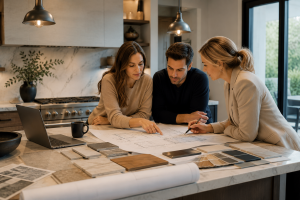
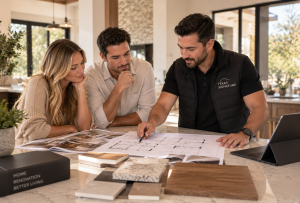
Design-build brings design and construction together under one coordinated team.
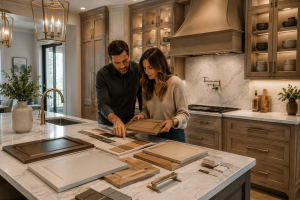
Instead of developing a complete design independently and then finding a contractor to build it, designers and construction professionals can collaborate from the early stages of the project.
That means conversations about layout and aesthetics can happen alongside conversations about materials, construction methods, feasibility, budget, and scheduling.
For homeowners, one of the biggest advantages is simplicity: there is a clearer point of accountability throughout the project.
If a design decision affects construction, the teams can address it together rather than leaving the homeowner responsible for coordinating separate companies.
What Is Traditional Construction?
The traditional approach is often called design-bid-build.
Typically, a homeowner first works with an architect or designer to develop plans. Once those plans are completed, contractors are invited to bid on the construction.
The homeowner then selects a contractor and moves into the building phase.
This model creates a clear separation between design and construction. For certain projects, particularly when a homeowner already has an architect or wants to competitively bid a completed set of plans, that separation can make sense.
The challenge is that the people designing the project and the people responsible for constructing it may not collaborate until relatively late in the process.
Design-Build vs. Traditional Construction at a Glance
| Design-Build | Traditional Construction | |
|---|---|---|
| Team Structure | Design + construction coordinated | Separate designer and contractor |
| Main Contact | More centralized | Multiple parties |
| Budget Input | Earlier in design | Often clearer after plans are developed |
| Builder Involvement | Early | Usually after design |
| Communication | Integrated | Homeowner may coordinate parties |
| Changes | Evaluated collaboratively | May require coordination between teams |
| Best For | Homeowners wanting an integrated process | Projects with completed plans or independent architect |
Neither approach is automatically right for every homeowner. The important difference is when collaboration happens and who is responsible for connecting all the pieces.
1. Budget Can Influence the Design Earlier
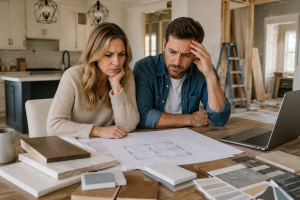
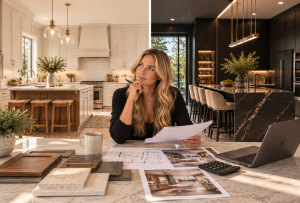
Imagine spending months designing a beautiful renovation only to discover during contractor bidding that building it will significantly exceed the intended budget.
This is one of the challenges that can occur when design and construction pricing happen separately.
With design-build, construction knowledge can enter the conversation earlier.
If one architectural detail is particularly expensive to execute, the team can explore alternatives while the design is still developing. If the homeowner wants to prioritize custom cabinetry, natural stone, or a larger addition, other decisions can be evaluated around those priorities.
The objective isn’t simply to make the project cheaper.
It’s to make design ambition and financial reality develop together.
2. Communication Becomes Simpler
A substantial remodel or custom home may involve designers, engineers, contractors, subcontractors, suppliers, permitting, inspections, and dozens of material selections.
Someone has to connect those conversations.
In a traditional structure, homeowners can sometimes find themselves between the designer and builder when questions arise.
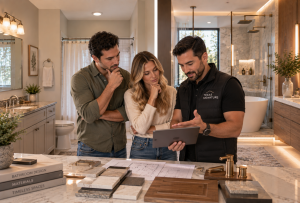
The contractor may say something needs to change in the plans. The designer may propose another solution. The homeowner then becomes responsible for understanding both perspectives and helping move the decision forward.
A design-build structure reduces much of that separation by putting those conversations within a coordinated team.
That doesn’t mean questions or challenges disappear. Construction is complex.
It means there is a clearer process for solving them.
3. Buildability Is Considered While Designing
There are many things that look wonderful on paper.
The more important question is whether they make sense for the actual home.
Existing structure, plumbing locations, mechanical systems, ceiling heights, site conditions, material availability, engineering requirements, and construction sequencing can all influence a design.
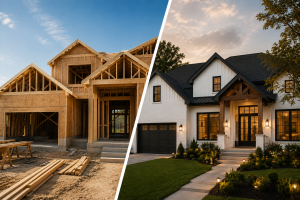
Early builder involvement allows those realities to be considered before plans become too difficult or expensive to change.
This becomes particularly valuable during whole-home remodeling and home additions, where new design needs to interact carefully with an existing structure.
The goal isn’t to restrict creativity.
It’s to create something beautiful that can also be built intelligently.
4. Changes Can Be Evaluated as a Team
Changes happen.
A wall may reveal an unexpected condition. A homeowner may fall in love with a different material. An appliance specification may change. Something that looked perfect on a drawing may need refinement once the physical space begins taking shape.
What matters is how those changes are handled.
When design and construction teams are already collaborating, a proposed change can be considered from multiple perspectives at once:
How will it look? How will it function? What will it cost? Will it affect the schedule? How should it be built?
That complete picture helps homeowners make better decisions instead of evaluating each issue in isolation.
5. Design-Build Can Create a More Cohesive Finished Home
A successful renovation should not feel like a collection of individual upgrades.
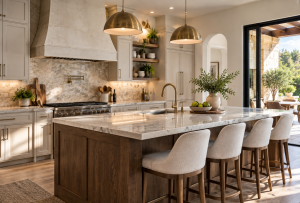
The cabinetry should relate to the architecture. Lighting should complement the materials. New rooms should connect naturally with existing spaces. An addition should feel like it belongs to the original house.
This is where coordination between design and construction becomes particularly valuable.
Details that might otherwise be addressed independently can be considered as part of one larger vision.
For us, that is one of the most exciting parts of the process.
When architecture, interior design, materials, craftsmanship, and construction begin supporting the same idea, the finished home feels intentional rather than assembled.
When Does Traditional Construction Make Sense?
Despite the advantages of design-build, traditional construction can still be the right choice.
For example, you may already have a trusted architect and a completed set of construction documents. You might also want several contractors to competitively bid exactly the same plans.
Some highly specialized architectural projects may also benefit from maintaining an independent architect throughout construction.
The important thing is understanding that separation requires strong communication.
Homeowners should know who is responsible for answering questions, approving changes, controlling costs, and coordinating conflicts between the plans and field conditions.
When Does Design-Build Make Sense?
Design-build can be particularly attractive when you are starting with an idea rather than completed construction documents.
You might know that your kitchen doesn’t work anymore, that your family needs additional space, or that you want to completely transform an older home—but you don’t yet know exactly what the solution should look like.
In that situation, having design and construction expertise available from the beginning allows possibilities to be explored alongside their practical implications.
It can work especially well for:
- Whole-home renovations
- Kitchen and bathroom transformations
- Home additions
- Major layout changes
- Custom homes
- Custom cabinetry and architectural details
- Projects where budget and design need to evolve together
For homeowners comparing design-build vs. traditional construction, the deciding factor often comes down to how integrated they want the experience to be.
The Right Process Should Give You Confidence Before Construction Begins
Regardless of which approach you choose, you should understand what happens next.
Who manages the project? Who controls the budget? Who handles design questions during construction? How are changes documented? Who coordinates permits and inspections? How frequently will you receive updates?
A beautiful portfolio is important, but these questions reveal something equally valuable: how the company actually works.
The construction process can last months. Choosing a team whose process you understand and communication style you trust matters just as much as choosing a design you love.
👉 You May Also Find These Helpful
👉 Planning Your Dream Home Remodel Step by Step
👉 7 Remodeling Decisions You’ll Never Regret
Design-Build With Texas Signature Design & Build
At Texas Signature Design & Build, we believe great projects happen when the people imagining a space and the people responsible for building it are working toward the same goal.
Our design-build approach allows us to consider architecture, interiors, cabinetry, materials, budget, scheduling, and construction as connected parts of the same project.
We serve homeowners throughout Huntsville, Conroe, The Woodlands, Spring, and surrounding Texas communities, working across custom homes, whole-home renovations, home additions, kitchen and bathroom remodeling, custom cabinetry, and other design-build projects.
If you’re comparing design-build vs. traditional construction, start by thinking beyond the finished home.
Think about the experience you want while creating it.
Because great construction is not only about getting the details right at the end. It’s about making thoughtful decisions together from the very beginning.